Likes, aber keine Stimme? Warum Social-Media-Kompetenz mehr ist als Follower zählen
[For the English version please scroll down]
Jugendliche in der Donauregion sind online – aber sind sie auch wirklich beteiligt? Ein Workshop in Eisenstadt hat gezeigt, wo die eigentlichen Lücken liegen.
Wer heute jung ist, wächst mit Social Media auf. Instagram, TikTok, YouTube – diese Plattformen sind nicht nur Unterhaltung, sie sind Kommunikationsraum, Identitätsraum, manchmal auch politischer Raum. Und doch: Dass junge Menschen viel Zeit online verbringen, heißt noch lange nicht, dass sie dort wirklich gehört werden. Oder dass sie wissen, wie sie sich Gehör verschaffen könnten.
Genau hier setzt das SMILE Incubator-Projekt an – Social Media Leadership Incubator for the Danube Region. Das EU-kofinanzierte Interreg-Projekt beschäftigt sich mit einer Frage, die einfacher klingt, als sie ist: Wie können junge Menschen soziale Medien nicht nur konsumieren, sondern aktiv und kompetent nutzen – für ihre Teilhabe an Gesellschaft und Politik?
Online sein ist nicht dasselbe wie teilhaben
Es ist ein Irrtum zu glauben, dass die Digitalisierung das Problem der Jugendbeteiligung automatisch gelöst hat. Ja, die Hürden zur Sichtbarkeit sind gesunken. Jede und jeder kann heute posten, kommentieren, teilen. Aber sichtbar sein ist nicht dasselbe wie Einfluss haben. Und Reichweite ist nicht dasselbe wie Wirkung.
Was Studien und Projektmappings immer wieder zeigen: Jugendliches Engagement bleibt oft auf einem niedrigen Intensitätsniveau – ein Like hier, ein Share dort, vielleicht ein Kommentar. Echte Beteiligung, also das Mitgestalten von Entscheidungen, das Sichtbarmachen eigener Anliegen, das Einbringen in politische Prozesse – das ist deutlich seltener. Und es ist kein Zufallsprodukt. Es setzt Kompetenzen voraus, die man erst erwerben muss.
Medienkompetenz bedeutet nicht, gut fotografieren oder Videos schneiden zu können. Es bedeutet, Informationen einordnen, Algorithmen verstehen, konstruktiv kommunizieren und die eigene Stimme bewusst einsetzen zu können.
Der blinde Fleck: ländliche und periphere Jugendliche
Noch deutlicher wird die Problematik, wenn man den Blick auf junge Menschen in ländlichen und peripheren Regionen richtet. Sie sind nicht weniger online – aber sie haben strukturell schlechtere Ausgangsbedingungen. Schwächere digitale Infrastruktur, weniger lokale Angebote, geographische Isolation, kaum institutionelle Ansprechpartner. Wer in einer Kleinstadt in der Donauregion aufwächst, hat schlicht weniger Zugang zu Räumen, in denen Beteiligung geübt und erlebt werden kann.
Das ist kein individuelles Problem. Es ist ein strukturelles. Und es reproduziert sich: Wer nie erlebt hat, dass seine Meinung zählt, engagiert sich seltener. Wer keinen Zugang zu Mentoring oder Netzwerken hat, entwickelt Führungskompetenzen schwerer. Die Lücke zwischen urbanen und ländlichen Jugendlichen wächst – nicht nur beim Internetzugang, sondern beim Zugang zu Teilhabe selbst.
Was beim Workshop in Eisenstadt deutlich wurde
Am 28. Mai 2026 kamen im Esterházy-Palais in Eisenstadt rund 20 Expertinnen und Experten, Projektpartner und Stakeholder zusammen – hybrid, also teils vor Ort, teils online – um genau diese Fragen zu diskutieren. Der Workshop war Teil der Aktivität A1.2 des SMILE Incubator-Projekts und hatte ein klares Ziel: nicht nur Probleme benennen, sondern konkrete politische Ansätze entwickeln.
Was die Diskussionen zeigten, war wenig überraschend in der Diagnose, aber umso wichtiger in der Schärfe: Jugendliche wollen sich beteiligen – aber nur dann, wenn sie das Gefühl haben, dass es etwas bewirkt. Symbolische Beteiligung, also das Anhören ohne Konsequenzen, frustriert und zieht sich zurück. Echte Mitgestaltung erfordert Transparenz, Rückmeldung und sichtbare Ergebnisse.
Flavia Enengl vom Team von EUSDR Priority Area 9 „People & Skills" (L&R Social Research) bettete diese Diskussion in den breiteren regionalpolitischen Rahmen ein. Sie verwies auf die ungleichen Entwicklungen in der Donauregion: Während Jugenderwerbsquoten in vielen Ländern gestiegen sind, zeigen PISA-Ergebnisse zwischen 2015 und 2022 einen deutlichen Rückgang in Basiskompetenzen – gerade in EU-Mitgliedsstaaten. Digitale Kompetenz und Citizenship-Skills gelten dabei zunehmend als Voraussetzungen nicht nur für gesellschaftliche Teilhabe, sondern auch für die Integration in den Arbeitsmarkt.
Führungskompetenz ist kein Workshop-Thema – sie braucht Zeit
Ein weiterer Punkt, der in Eisenstadt immer wieder auftauchte: Führungskompetenz lässt sich nicht in einem Seminar vermitteln. Sie entsteht durch kontinuierliche Begleitung, Mentoring, durch das Erleben von Verantwortung in geschützten Räumen. Was Jugendliche in der Donauregion häufig fehlt, sind genau diese Strukturen: Mentoringprogramme, die über Projektlaufzeiten hinaus bestehen, Kooperationen zwischen Schulen, Gemeinden und Jugendorganisationen, die nicht projektabhängig sind.
Stattdessen dominieren punktuelle Angebote. Ein Workshop hier, ein Seminar dort. Wertvolle Impulse – aber ohne Anschluss, ohne Nachbetreuung, ohne die Einbettung in eine längerfristige Begleitstruktur. Was nachhaltig wirkt, ist anders: Jugendliche, die regelmäßig in Entscheidungsprozesse eingebunden sind, die wissen, an wen sie sich wenden können, die Vorbilder und Begleitung haben.
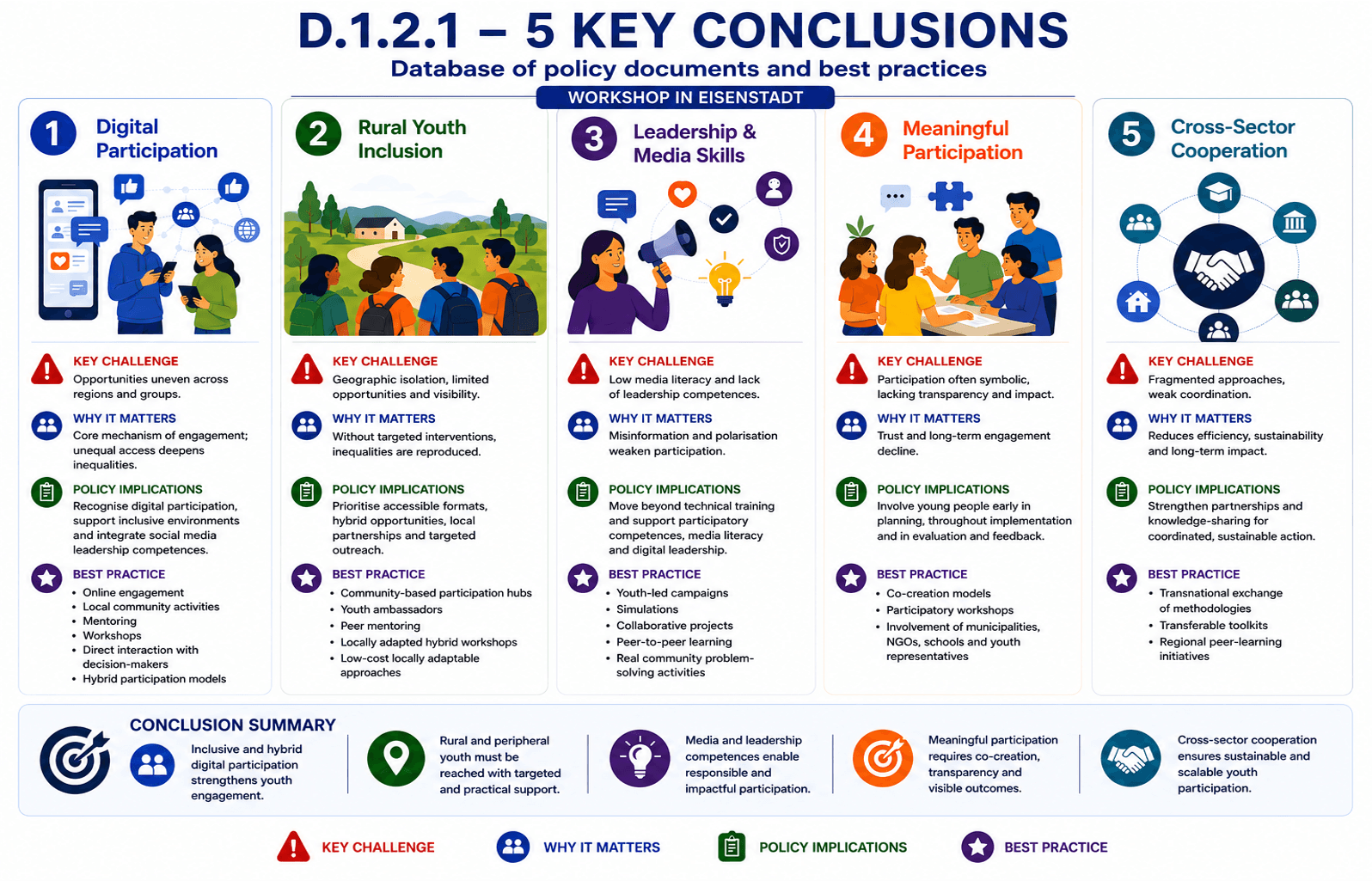
Grafik: Jasminka Samardžija - RIT Croatia, präsentiert beim SMILE Incubator Workshop, Eisenstadt, 28. Mai 2026. Erstellt mit KI-Unterstützung (ChatGPT/DALL·E)
Welche Kompetenzen wirklich gebraucht werden
Im Workshop kristallisierte sich heraus, was eine zeitgemäße Medienkompetenzförderung leisten müsste – und es geht weit über „sicher im Internet surfen" hinaus:
Kritisches Denken und Faktenchecks – in einer Zeit, in der Desinformation algorithmisch verstärkt wird, ist die Fähigkeit zur Einordnung essenziell.
Algorithmusbewusstsein – zu verstehen, warum man bestimmte Inhalte sieht und andere nicht, ist eine Grundvoraussetzung für mündige Mediennutzung.
Politische und partizipative Alphabetisierung – zu wissen, wie politische Prozesse funktionieren und wie man sie beeinflussen kann.
Konstruktive Online-Kommunikation – in einer polarisierten digitalen Öffentlichkeit sachlich und respektvoll zu diskutieren, will gelernt sein.
Kollaborative Führung und Projektmanagement – denn Beteiligung ist selten ein Einzelprojekt.
Diese Kompetenzen bilden gemeinsam das, was man als „Participation Literacy" bezeichnen könnte: die Fähigkeit, sich als aktive, informierte und selbstbewusste Bürgerin oder Bürger einzubringen – online wie offline.
Was Politik leisten kann – und was nicht
Der Policy-Lab-Teil des Workshops machte deutlich: Die Lösungen müssen auf mehreren Ebenen ansetzen. Lokal braucht es dauerhaft verankerte Beteiligungsstrukturen – Jugendbeiräte, Anlaufstellen, Mentoringprogramme. National müssen Medienkompetenz und Führungsförderung in Bildungsrahmenpläne integriert werden, nicht als Zusatzangebot, sondern als Kernaufgabe. Und auf EU- und Donauregionsebene braucht es den transnationalen Austausch: Was in einem Land gut funktioniert, kann anderswo adaptiert werden.
Was Politik allein nicht kann: die Strukturen von unten ersetzen. Institutionen können Räume schaffen, Ressourcen bereitstellen, Rahmenbedingungen setzen. Aber gelebte Beteiligung entsteht dort, wo junge Menschen echte Ansprechpartner haben, wo Vertrauen gewachsen ist, wo Engagement sichtbar belohnt wird – nicht mit Zertifikaten, sondern mit Wirkung.
Nächste Schritte im SMILE-Projekt
Die Ergebnisse des Workshops in Eisenstadt fließen direkt in die weiteren Projektphasen ein. Sie bilden die inhaltliche Grundlage für die Policy Suggestions (D1.2.3) und die Strategic Guidelines for Social Media Leadership (D1.2.4), die gemeinsam mit Partnerorganisationen aus der gesamten Donauregion erarbeitet und validiert werden.
Der nächste Schritt: Konsultation, Rückkopplung, Dissemination. Denn auch das gehört zum Projekt – die Erkenntnisse nicht in Schubladen verschwinden zu lassen, sondern dorthin zu bringen, wo sie gebraucht werden.
Der SMILE Incubator – Social Media Leadership Incubator for the Danube Region – wird im Rahmen des Programms Interreg Danube Region ko-finanziert durch die Europäische Union.
💬 Wir freuen uns über Anmerkungen, Einordnungen und weiterführende Perspektiven in den Kommentaren.
Likes, but No Voice? Why Social Media Skills Are About More Than Follower Counts
Young people across the Danube Region are online – but are they truly participating? A workshop held in Eisenstadt brought into sharp focus where the real gaps lie.
Growing up today means growing up with social media. Instagram, TikTok, YouTube – these platforms are not just entertainment. They are spaces for communication, identity and, increasingly, political expression. And yet: the fact that young people spend a great deal of time online does not mean they are genuinely heard there. Or that they know how to make themselves heard.
This is precisely where the SMILE Incubator project comes in – the Social Media Leadership Incubator for the Danube Region. Co-funded by the EU through the Interreg Danube Region programme, the project addresses a question that sounds simpler than it is: how can young people use social media not just as consumers, but as active, competent participants in society and public life?
Being Online Is Not the Same as Taking Part
There is a common misconception that digitalisation has automatically solved the problem of youth participation. Yes, the barriers to visibility have lowered. Anyone can post, comment or share. But being visible is not the same as having influence. And reach is not the same as impact.
Research and policy mapping consistently show that youth engagement tends to remain low-intensity – a like here, a share there, perhaps the occasional comment. Genuine participation – shaping decisions, making one's concerns visible, engaging in political processes – is far less common. And it is not accidental. It requires competences that have to be learned and practised.
Media literacy does not mean knowing how to take a good photo or edit a video. It means being able to contextualise information, understand algorithms, communicate constructively and use one's voice with purpose.
The Blind Spot: Rural and Peripheral Youth
The challenge becomes even more pronounced when we turn our attention to young people in rural and peripheral areas. They are not less online – but they face structurally worse starting conditions. Weaker digital infrastructure, fewer local opportunities, geographical isolation, and limited institutional support. Growing up in a small town in the Danube Region often means having less access to spaces where participation can be practised and experienced.
This is not an individual problem. It is a structural one – and it reproduces itself. Those who have never experienced that their opinion matters are less likely to engage. Those without access to mentoring or networks find it harder to develop leadership skills. The gap between urban and rural youth widens – not just in terms of internet access, but in access to participation itself.
What the Workshop in Eisenstadt Made Clear
On 28 May 2026, around 20 experts, project partners and stakeholders gathered at the Esterházy Palace in Eisenstadt – in a hybrid format, with participants both on-site and online – to discuss exactly these questions. The workshop was part of Activity A1.2 of the SMILE Incubator project and had a clear purpose: not just to name problems, but to develop concrete policy approaches.
What the discussions revealed was unsurprising in its diagnosis, but striking in its clarity: young people want to participate – but only when they feel it makes a difference. Symbolic participation, being consulted without consequence, leads to frustration and withdrawal. Genuine co-creation requires transparency, feedback and visible outcomes.
Flavia Enengl from the EUSDR Priority Area 9 "People & Skills" team (L&R Social Research) placed the discussion in its broader regional policy context. She pointed to the uneven developments across the Danube Region: while youth employment rates have risen in many countries, PISA results between 2015 and 2022 show a significant decline in basic skills – particularly in EU member states. Digital competence and citizenship skills are increasingly recognised as prerequisites not only for social participation, but for labour market integration as well.
Leadership Competence Is Not a Workshop Topic – It Takes Time
Another theme that surfaced repeatedly in Eisenstadt: leadership competence cannot be taught in a single seminar. It develops through continuous mentoring, through taking on responsibility in supported environments, through sustained engagement over time. What young people across the Danube Region often lack are precisely these structures – mentoring programmes that outlast individual project cycles, cooperation between schools, municipalities and youth organisations that does not depend on project funding.
What tends to dominate instead are one-off offers. A workshop here, a training session there. Valuable impulses – but without follow-up, without continuity, without being embedded in a longer-term support structure. What actually works looks different: young people who are regularly involved in decision-making processes, who know who to turn to, who have role models and sustained guidance.
The Competences That Are Actually Needed
The workshop made clear what a genuinely contemporary approach to media literacy would need to deliver – and it goes well beyond "staying safe online":
Critical thinking and fact-checking – in an era where misinformation is algorithmically amplified, the ability to assess and contextualise information is essential.
Algorithm awareness – understanding why certain content is shown and other content is not is a basic requirement for informed media use.
Political and participatory literacy – knowing how political processes work and how to engage with them meaningfully.
Constructive online communication – in an increasingly polarised digital public sphere, the ability to engage respectfully and substantively is a skill that must be learned.
Collaborative leadership and project management – because meaningful participation is rarely a solo endeavour.
Together, these competences form what might be called "participation literacy": the capacity to engage as an active, informed and self-confident citizen – online and offline alike.
What Policy Can Achieve – and What It Cannot
The Policy Lab sessions of the workshop made one thing clear: solutions need to operate on multiple levels. Locally, there is a need for permanently anchored participation structures – youth advisory bodies, accessible contact points, mentoring programmes. At national level, media literacy and leadership development need to be integrated into educational frameworks – not as optional extras, but as core responsibilities. And at EU and Danube Region level, transnational exchange matters: what works well in one country can be adapted elsewhere.
What policy alone cannot do is replace grassroots structures. Institutions can create spaces, provide resources and set frameworks. But lived participation emerges where young people have real points of contact, where trust has grown over time, where engagement is visibly rewarded – not with certificates, but with impact.
Next Steps in the SMILE Project
The results of the Eisenstadt workshop feed directly into the next phases of the project. They form the substantive foundation for the Policy Suggestions (D1.2.3) and the Strategic Guidelines for Social Media Leadership (D1.2.4), which are being developed and validated in close collaboration with partner organisations from across the Danube Region.
The next step: consultation, feedback, dissemination. Because that too is part of the project – ensuring that insights do not disappear into drawers, but reach the people and institutions where they are needed.
The SMILE Incubator – Social Media Leadership Incubator for the Danube Region – is co-funded by the European Union through the Interreg Danube Region programme. The project is organised by the Foster Europe Foundation for strong European Regions.
💬 We welcome comments, reflections and further perspectives in the discussion.